
Reading Circle meets the 2nd and 4th Monday of the month at 4pm PST/7pm EST/12am UTC.
Reading Circle is a space for women to explore feminist literature as a group. Every week, we will read a short essay or excerpt of writing about feminist theory or women’s herstory, then discuss. Please read or listen to the text before each session, so we can come together for a thoughtful discussion!
About The Author
Kathie Sarachild was one of the founding members of New York Radical Women and one of the early members of The Redstockings. She is responsible for coining the phrase, "sisterhood is powerful" in a speech she gave at the first New York Radical Women's public action. She was also one of the four organizers of the famous 1968 Miss America Pageant Protest. She began her activism in 1967 and is still active today.
This piece went through several iterations before it became what we are reading, which was published in 1978 in Feminist Revolution, an anthology compiled and edited by The Redstockings. Like many early second wave texts, it was at one point a speech, than a presentation. After conversation with other feminist, it evolved and was eventually written down for wider distribution years after the initial idea was formed.
Recording
Text
You can read this weeks text by following this link.
You can also download a PDF version here:
Optional Reading
If you're interested, here is a booklet from FiLiA with instructions on how to start a contemporary CR group.
Key Concepts
Radical
Radical originally meant “of, relating to, or proceeding from a root,” coming from the Late Latin radicalis and Latin radic-/radix meaning “root.” In this sense, it denotes something that goes to the foundation or origin of a thing — the fundamental basis — which later extended metaphorically to concepts of thoroughgoing or extreme change because such change is understood as occurring at the root of a system or idea (Merriam-Webster, n.d.).
Zap
A zap in political activism is a direct, theatrical protest action — a short, disruptive, attention-grabbing intervention aimed at confronting public figures, institutions, or cultural norms to force public attention on an issue (Blakemore, 2021).
Reading Questions
- What was your conception of consciousness-raising or CR before you read this? How does that differ from what the author describes here?
- The author describes how the women who started doing CR didn't see themselves as novices at feminism or politics, but learned alongside those women who were newcomers in their groups. Can you describe the tone or the characteristics of a group that would facilitate this kind of learning?
- The first CR group here had a few guidelines; the topics were only those related to women's lived, women could read to prepare but were not required to, they were focused on whose interests were being served in maintaining women's oppression and the objective was actions/zaps. Why do you think these guidelines worked so well for them? How do you think they would need to be updated for contemporary use?
- Why do you think these women and other early CR groups were so effective at studying male supremacy and breaking down concepts like "other women" that stood in the way of feminist consciousness?
- When reading "The Resistance" section, did anything stand out to you? Why?
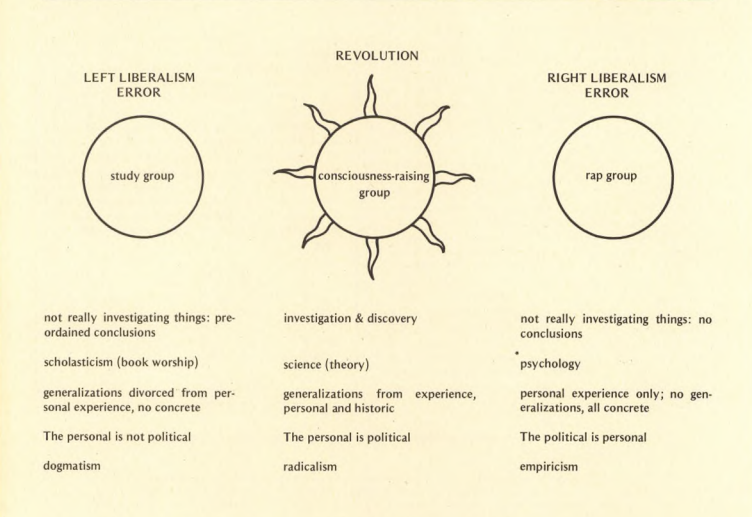
- What do you think about calling CR groups "study groups"? What do you think of them explicitly looking for ways to organize "radical" women to take action for "revolutionary change"?
- There are many methods through which CR can take place, but the author describes a committed group of women all giving testimony on one topic in an effort to gain a deeper understanding about the mechanism of male supremacy in women's lives. Do you think you would like to take part in a CR group that operated that way? Do you have a different idea for how a CR group might function?
References
Merriam-Webster. (n.d.). Radical. In Merriam-Webster.com dictionary.
Code of Participation
If you have questions, please read and review our Feminist Code Of Participation.


